


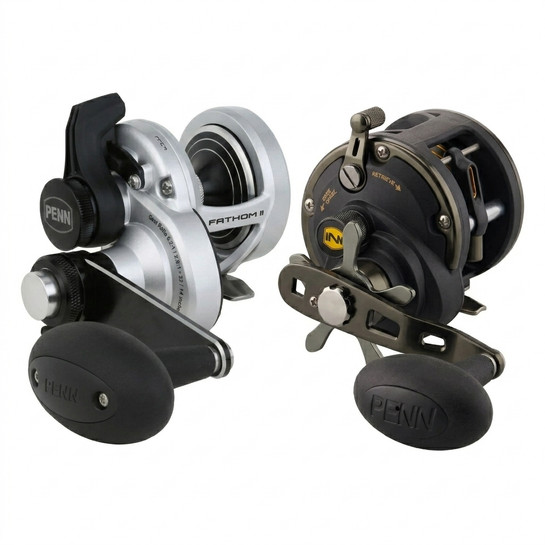
Understanding the Internal Mechanics, Lever Drag VS Star Drag Reels
Posted by Mike on 2026 Aug 22nd
When big-game anglers test the limits of conventional fishing reels, long-term durability often comes down to internal mechanical engineering rather than raw material strength. While both star drag and lever drag reels have earned legendary status on the water, their internal drive systems handle high-tension loads in fundamentally different ways. The single most crucial structural distinction between the two lies in how stopping force is applied to the rotating spool—specifically, whether the reel's gear teeth are forced to bear that mechanical strain.
Understanding the Internal Mechanics
To appreciate why one design outlasts the other under sustained heavy drag pressure, you must look at how each reel engages and disengages the spool during operation.
In a star drag reel, the drive gear and pinion gear physically separate from the spool shaft when you push the clutch lever into free spool. The pinion gear slides away along the spool shaft, disengaging its drive slots or pins. When you turn the handle to re-engage the reel, an internal yolk snaps the pinion gear back into position, meshing its teeth with the main gear while simultaneously locking onto the spool shaft. Because the star drag stack sits inside the main gear, any torque required to stop or slow the rotating spool must travel through the intermeshed teeth of the main gear and pinion gear before reaching the drag washers.
Conversely, a lever drag reel features a permanently engaged drive train where the main gear and pinion gear remain in constant mesh at all times. The entire spool floats on a heavy-duty central shaft. When you push the drag lever forward, a cam mechanism slides a thick metal pressure plate laterally across the shaft, pressing it directly against a fiber drag washer mounted directly on the spool's side plate.
The Gear-Tooth Bottleneck in Star Drag Reels
Because a star drag reel relies on its gear teeth to bridge the gap between the drag stack and the spool shaft, those tiny gear teeth absorb extreme shear stresses:
-
Shock Load Damage: Throwing a star drag reel back into gear while line peels off at high speed subjects the narrow pinion gear teeth to immediate, violent impact.
-
Tooth Rounding and Shearing: Over time, absorbing the rotational inertia of a running fish causes the brass or stainless-steel gear teeth to round off, micro-fracture, or strip completely.
-
Frame Flex Vulnerability: Under maximum drag pressures, minor torsional flexing in the reel frame forces the main gear and pinion gear slightly out of alignment. This concentrates the entire drag load onto the tips of just one or two gear teeth rather than spreading it evenly across the tooth profile.
How Lever Drags Isolate the Drive Train
Lever drag designs sidestep these mechanical failure points by isolating the gear train from the stopping mechanism entirely:
-
Direct Surface Area Engagement: Braking force is applied straight to the face of the spool via large-diameter drag discs. The stopping friction is converted into heat across a wide surface area without touching a single gear tooth.
-
Zero Clutch Engagement Shock: Because the pinion gear and main gear never disengage, there is no mechanical step where gear teeth must "catch" a spinning spool. Advancing the drag lever simply increases axial pressure against the spool disc.
-
Axial Force Distribution: The physical load generated by stopping a fish pushes linearly along the solid central shaft rather than trying to twist or shear the drive gears sideways.
Comparative Durability Breakdown
| Feature / Metric | Star Drag Reel | Lever Drag Reel |
| Spool Stopping Method | Driveshaft/Pinion gear teeth transfer load to main gear drag stack | Pressure plate compresses drag washer directly against spool face |
| Gear Train State | Pinion disengages in free spool; re-engages under load | Main gear and pinion gear remain in constant mesh |
| Primary Failure Point | Stripped or worn pinion teeth, rounded drive gears | Angular contact bearing wear from lateral thrust |
| Drag-Induced Gear Wear | High (gears bear full torque of spool retardation) | Virtually Zero (gears handle handle-turn torque only) |
| High-Tension Engagement | Risks immediate mechanical gear failure | Smooth, progressive ramp-up with zero gear shock |
Practical Performance Implications
While star drag reels remain widely popular for bottom fishing, surf casting, and applications where maximum free-spool distance and light weight are paramount, they require more frequent gear replacements if fished hard near their maximum drag thresholds.
Lever drag reels are undeniably more durable when subjected to brutal, long-duration battles with large pelagic species. By eliminating gear-tooth load during spool braking, the lever drag architecture protects the drive train from catastrophic failure, ensuring that the gears only experience stress when you actively turn the handle to retrieve line.