


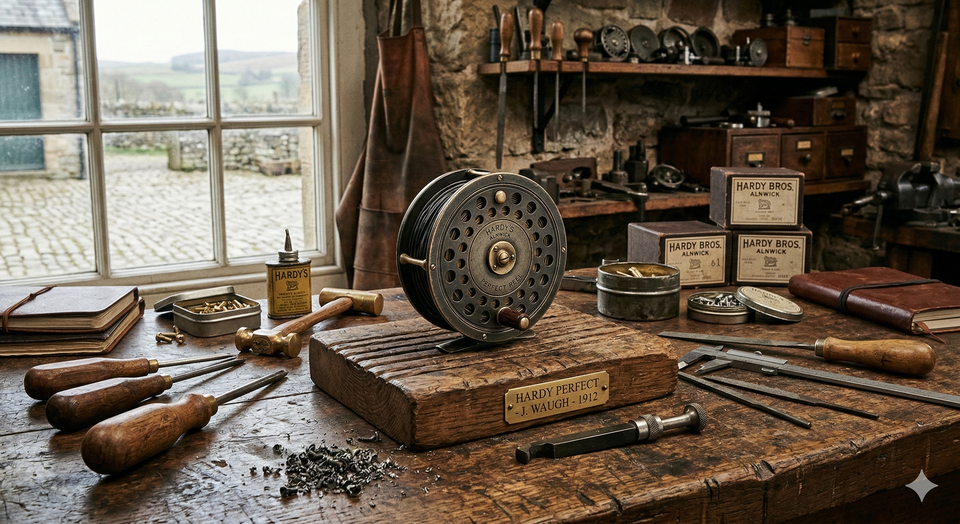
The Ghosts in the Machine: A Guide to Hardy’s Master Reel Makers and Their Legends
Posted by Mike on 2026 Mar 7th
For the uninitiated, a fly reel is a simple tool—a spool to hold line. But for the cult of Hardy Brothers of Alnwick, a reel is a piece of industrial soul. Since the late 19th century, Hardy has operated under a philosophy that would make modern "efficiency experts" weep: One Man, One Reel.
In the Alnwick factory, a single craftsman would take a pile of components and stay with them until a finished, clicking masterpiece emerged. Before the reel left their bench, they would stamp their initials inside the frame. To a collector, those tiny letters aren't just marks; they are signatures of a lineage.
If you’ve ever cracked open a vintage Perfect or a St. George and wondered who "J.S." or "R.B." was, you’re looking at the DNA of fly fishing history. Here is the definitive breakdown of the hands that built the legends.
The Masters of the Bench: A Chronology of Initials
Finding a reel with these initials is like finding a signed first edition. These men were the elite of the Alnwick workshop.
| Maker Initials | The Name Behind the Stamp | Active Era | Specialization & Legacy |
| R.B. | Robert Borthwick | 1890–1920 | The pioneer. He built the very first brass-faced Perfects. |
| D | William Dingley | 1891–1911 | A legend who later started his own famous firm. Master of the Silex. |
| J.W. | John "Jackie" Waugh | 1893–1916 | Known for the "Contracted" Perfects that collectors drool over. |
| A.H.W. | Arthur Wall | 1901–1939 | The heavy hitter. He specialized in massive sea reels and the Fortuna. |
| J.S. | Jimmy Smith | 1908–1960 | The "Iron Man" of Hardy. If you own a vintage Hardy, there's a 40% chance Jimmy built it. |
| T.A. | Thomas Appleby | 1920–1947 | The man behind the original, ultra-rare 1930s Cascapedia. |
| T.A.G. | Thomas Armstrong | 1928–1978 | Bridged the gap between the pre-war "lead" finish and modern alloys. |
| J.A.J. | Joe Johnson | 1936–1966 | A specialist in the Altex and high-precision tournament reels. |
The Evolution of the Reel: A Timeline of Innovation
While the makers provided the soul, the Hardy family provided the engineering. If you are trying to date your reel, the model is your best roadmap.
1891: The Perfect
The "OG" of fly reels. It featured a ball-bearing race that made it smoother than anything else on the market. Over the years, it evolved through several "check" (drag) mechanisms:
-
1896 Check: Very rare, featuring a "tongue" style clicker.
-
1912 Check: The holy grail for many, featuring a heavy-duty, adjustable tensioner.
-
1917 Check: The refined, classic "Mark II" design that remained the standard for decades.
1903: The Bouglé
Named after the French angler Louis Bouglé, who wanted a "lighter" version of the Perfect. It is easily identified by its raised pillars and white handle. It remains one of the most aesthetically pleasing reels ever made.
1911: The St. George
This was the first reel to truly popularize the Agate line guard. That circular piece of gemstone isn't just for show; it prevents the fly line from wearing grooves into the metal frame. If you find one with an uncracked red agate, you’ve hit the jackpot.
1921: The Uniqua
The "Everyman's" Hardy. It lacked the ball bearings of the Perfect, making it cheaper and lighter, but it was built with the same "One Man" precision. It’s a workhorse that still fishes beautifully 100 years later.
1958–1964: The Lightweight Revolution
Post-WWII, Hardy moved toward magnesium-aluminum alloys. This era gave us the L.R.H. Lightweight (named after Lawrence Robert Hardy), the Princess, and the tiny Flyweight. These reels defined the mid-century trout fishing aesthetic.
Identifying Your Prize
If you've got a Hardy in your hand, check these three things to confirm its pedigree:
-
The Foot: Early reels have brass feet (often "ribbed"). Post-war reels transitioned to smooth alloy feet.
-
The Finish: Pre-1940s reels often have a dark, "leaded" finish that wears into a beautiful gunmetal grey. Later reels use a hard-enamel "sun-tan" or black finish.
-
The Internals: Pop the spool. If you see initials like J.S. or T.A.G. stamped into the frame, you aren't just holding a reel—you’re holding a piece of Thomas or Jimmy’s life work.
Hardy reels aren't just about catching fish; they are about a connection to a rainy workshop in Northumberland where "good enough" was never an option.